Show your results by stimulus, too
graphs
If your research involves participants reacting to linguistic stimuli such as words, sentences, or vignettes, there’s a pretty simple way to make your articles and presentations more informative: Also show the results aggregated by stimuli rather than just by participants. Regardless of whether or not you’re fitting mixed-effects models incorporating random effects for stimuli, such by-stimulus visualisations may help both you and your readership identify patterns in the data that a by-participant visualisation would gloss over and guard against premature conclusions.
Examples
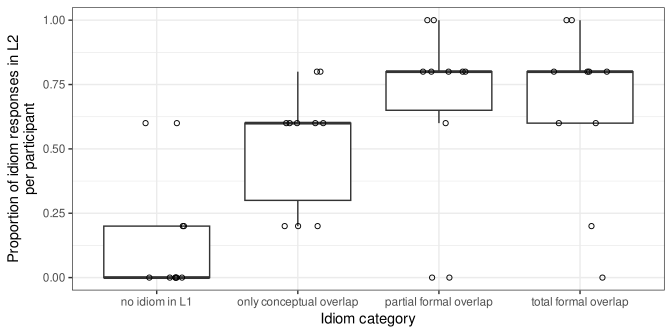
As a simple first example, consider a small-scale study by Kuster (2018), in which the student-author sought to replicate a study by Laufer (2000) in a different setting. Ten English-speaking learners of L2 German were given twenty fill-in-the-blank sentences that targeted German idioms. Following Laufer (2000), the idioms were separated into four categories:
- German idioms for which Kuster (2018) could not identify a corresponding English idiom (e.g., sich aus dem Staub machen ‘to make off’);
- German idioms for which Kuster found a corresponding English idiom with no formal overlap to the German idiom (e.g., Ich verstehe nur Bahnhof ‘It’s all Greek to me’; literally ‘I only understand railway station’). This category is referred to as only conceptual overlap;
- German idioms with a formally somewhat similar English counterpart (e.g., Katzen hageln ‘to rain cats and dogs’). This category is referred to as partial formal overlap;
- German idioms with a formally very similar English counterpart, that is, the German and English idioms are essentially literal translations of one another (e.g., zwischen den Zeilen lesen ‘to read between the lines’). This category is referred to as total formal overlap.
The expectation was that the learners would tend to give more idiom responses to the higher-numbered categories than to the lower-numbered ones. The results in Figure 1 are in line with these expectations.
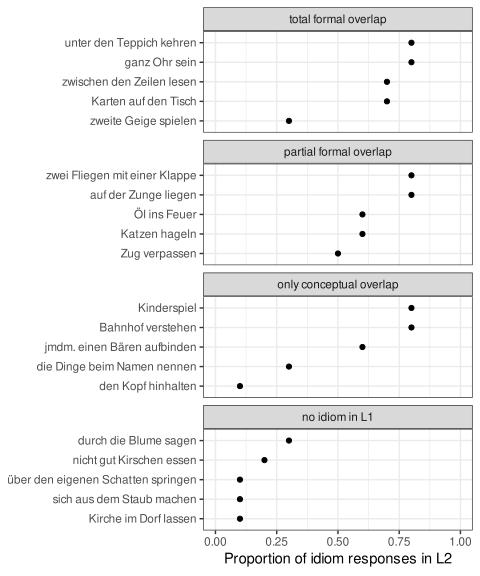
The boxplots with the individual participants’ results overlaid are already much better than a typical bar chart that only shows the mean proportion for each idiom category. My suggestion, though, is to also show the variability in the data by idiom, as in Figure 2.
This Cleveland dotplot has a few things going for it.
First, it illustrates the extent to which stimuli within a single category differ in how frequently they elicit a certain response. This, hopefully, helps guard against prematurely reifying fairly abstract stimulus categories and their role in language learning. In this example, the results for the only conceptual overlap category overlap with those for all other categories so that it’s clear that we can predict little about any future idiom we might assign to this category.
Second, stimulus labels, more often so than participant labels, carry meaning. In Cleveland dotplots, we can include these labels. Sometimes, these labels may help us or our readership to come up with reasonable accounts for the by-stimulus variability. Further, as in the present case, they highlight that the categories are to some extent arbitrary, and readers may call into question some classifications. For instance, someone with sufficient German and English may look at Figure 2 and rightly wonder why Kinderspiel ‘child’s play’ is in the only conceptual overlap category rather than in one of the formal overlap categories. The categorisation of some other idioms can similarly be questioned.
Third, readers who disagree with some categorisations can nonetheless gauge if the overall results would change if the stimuli were to be categorised differently. In this example, assigning Kinderspiel to one of the formal overlap categories wouldn’t affect the overall finding.
As a second example, consider an older study of mine (Vanhove 2017), in which I asked a number of Dutch-speaking participants from the Netherlands (NL) and Belgium (BE) to assign articles to German nouns with Dutch cognates. Figure 3 shows how often these participants assigned the neuter article das to four categories of nouns:
- neuter German (Gm.) nouns with a neuter Standard Dutch (St. Du.) cognate (e.g., Gm. Brot – St. Du. brood ‘bread’);
- masculine or feminine German nouns with a neuter Standard Dutch cognate (e.g., Strand ‘beach’, which is masculine in German but obviously should be neuter);
- neuter German nouns with a common Standard Dutch cognate1 (e.g., Gm. Beil – St. Du. bijl ‘axe’; another aberration of the German language);
- masculine or feminine German nouns with a common Standard Dutch cognate (e.g., Berg ‘mountain’).
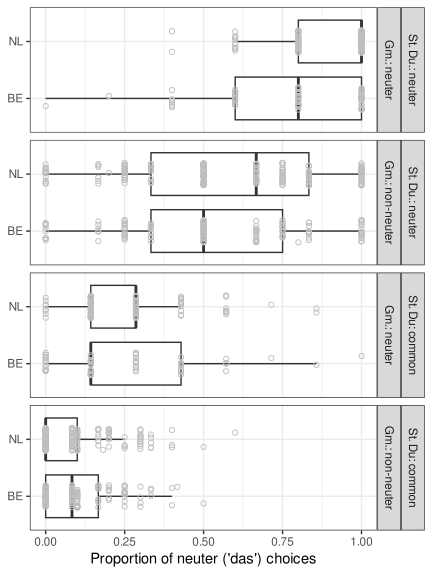
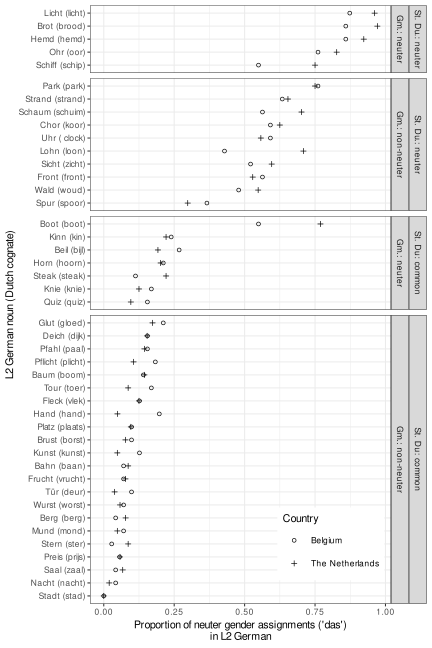
These boxplots are all right. But I like the Cleveland dotplot in Figure 4 much better because the data points carry much more meaning. First, it highlights that, on the word level, there is hardly any overlap between nouns with neuter cognates and those with common cognates, suggesting that Standard Dutch gender strongly influences these participants’ responses. The sole exception to this pattern is easily identified to be Boot, which can plausibly be explained by the participants’ being familiar with the film Das Boot. And in case anyone was wondering whether the tendency of people from Antwerp to refer to Antwerp as _‘t Stad_ ’the city’, which could be superficially read as considering stad to be neuter rather than common2, has any consequences, the dotplot shows that none of the participants assigned a neuter article to its German cognate Stadt.
Tips
Tip 1. Cleveland dot plots tend to work well for results aggregated by stimuli as you can put the stimuli themselves or some shorter form of them in the graph. Don’t use bar charts; they tend to be too busy.
Tip 2. When working with facets (e.g., for different stimulus categories), impose some sensible ordering. For instance, you could sort the facets by the average response on the stimuli occurring in it.
Tip 3. Similarly, impose some sensible ordering on the stimuli within the facets.
Tip 4. Have the graph show the item labels horizontally rather than vertically.
References
Kuster, Sara. 2018. Die Rolle der zwischensprachlichen Ähnlichkeit von Englisch und Deutsch bei der Produktion von Redewendungen in DaZ. Term paper. University of Fribourg.
Laufer, Batia. 2000. Avoidance of idioms in a second language: The effect of L1-L2 degree of similarity. Studia Linguistica 54(2). 186–196.
Vanhove, Jan. 2017. The influence of Standard and substandard Dutch on gender assignment in second language German. Language Learning 67(2). 431–460.
Footnotes
For all intents and purposes, Standard Dutch doesn’t distinguish between masculine and feminine gender adnominally. The merger of masculine and feminine gender resulted in a common (non-neuter) gender category. Lots of Flemish dialects still do to some extent, though. In these dialects, the distinction between masculine and feminine genders is especially marked on the indefinite article (e.g., ne voet ‘a foot (m.)’ but een hand ‘a hand (f.)’).↩︎
In Standard Dutch, ’t is a reduced form of the neuter article het. But in ’t stad it can best be understood as a misspelling of d’, which would be a reduced form of the common article de and which is affected by anticipatory devoicing.↩︎