Computes posterior mean predictions from a Gaussian process regression model given precomputed kernel matrices. The implementation follows Algorithm 2.1 in Rasmussen and Williams (2006), with an optional centring step and automatic jitter escalation to handle near-singular kernel matrices.
Arguments
- Kxx
Kernel matrix evaluated at the training inputs.
- Kxstar
Matrix of kernel values between test and training inputs. Each row corresponds to one test input.
- y_train
Vector with training outcomes.
- centre
If
TRUE, the training outcomes are centred around their mean.- lambda2
Kernel noise variance.
- Kxstarstar
Optional. A square matrix of kernel values among the test inputs. If
NULL(default), only posterior means are computed and returned as a vector. Else both the posterior mean vector and covariance matrix are returned.
Value
If Kxstarstar is NULL (default), a vector with posterior mean
predictions for the test inputs. Else, a list with a vector
test_predictions with posterior mean predictions and a matrix test_variance with the posterior
covariance for the test inputs.
Examples
N1 <- 25
N2 <- 10
x_train <- seq(-pi, pi, length.out = N1)
x_test  <- runif(N2, -pi, pi)
distance <- outer(c(x_train, x_test), c(x_train, x_test), "-") |> abs()
kernel <- rbf(distance, length_scale = 1, variance = 1)
Kxx    <- kernel[1:N1, 1:N1]
Kxstar <- kernel[(N1+1):(N1+N2), 1:N1]
Kxstarstar <- kernel[(N1+1):(N1+N2), (N1+1):(N1+N2)]
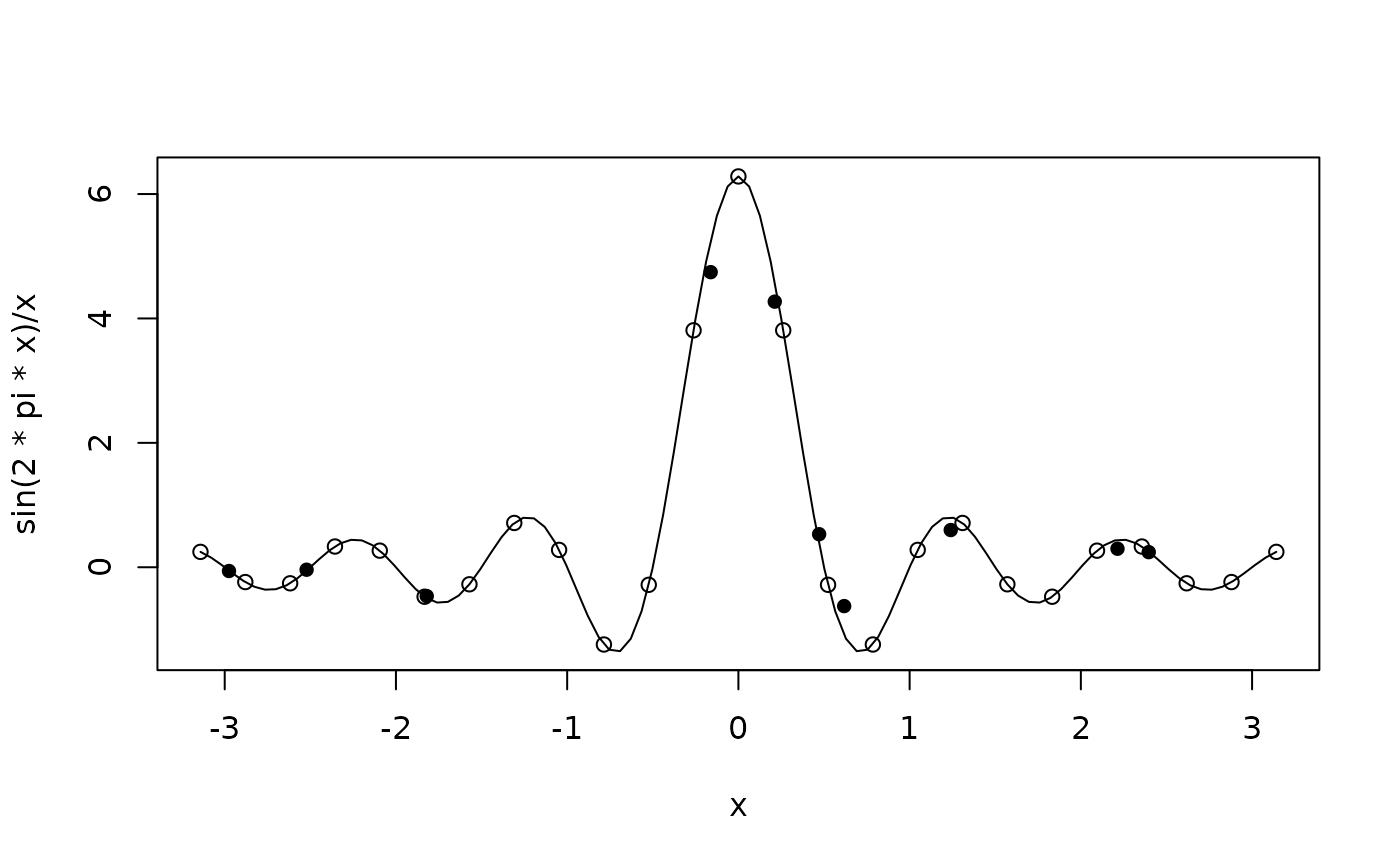
y_train <- ifelse(x_train == 0, 2*pi, sin(2*pi*x_train) / x_train)
curve(sin(2*pi*x)/x, from = -pi, to = pi)
points(x_train, y_train)
# Only means: don't use Kxstarstar
points(x_test, gpr_predict(Kxx, Kxstar, y_train), pch = 16)
# Add credible intervals around predictions:
gpr_fit <- gpr_predict(Kxx, Kxstar, y_train, Kxstarstar = Kxstarstar)
segments(x0 = x_test,
         y0 = gpr_fit$test_predictions - 2 * sqrt(diag(gpr_fit$test_variance)),
         y1 = gpr_fit$test_predictions + 2 * sqrt(diag(gpr_fit$test_variance)), col = "#4DAF4A")